
FOLLOWING THE KAZAGLIA BROTHERS AND THEIR FLOCK FROM AEPOS TO MESTA AND BEYOND
📷 14–15 December 2024
For years, I’d heard stories about shepherds who would leave the northern mountains of Chios to winter with their animals in the southern part of the island. I was looking for a chance to follow them, record the journey, and experience it firsthand. Last year, I tried but didn’t manage to make it happen. It’s not a given that the shepherds and their dogs want you along. This year, however, I was luckier and walked with the Kazaglia brothers, Vassilis and Elias – probably the only Chian shepherds who still sleep outdoors, mid-journey, like in the old days.
Saturday, December 14, 2024, I arrive at their sheepfold in Achlada, Aepos. They’re eager to start the long trek, while one of their three shepherd dogs growls at me. Elias opens the gate, and hundreds of goats and fewer sheep pour out. Vassilis takes the lead with the dogs, while Elias, the lovable shepherd Yiannis Boulas (who came to help), and I bring up the rear. “Cretans say ‘we’re going to the winter pastures,’ we say ‘we’re going to the place,’” Yiannis told me in his characteristic husky voice.
For years, I’d heard stories about shepherds who would leave the northern mountains of Chios to winter with their animals in the southern part of the island. I was looking for a chance to follow them, record the journey, and experience it firsthand. Last year, I tried but didn’t manage to make it happen. It’s not a given that the shepherds and their dogs want you along. This year, however, I was luckier and walked with the Kazaglia brothers, Vassilis and Elias – probably the only Chian shepherds who still sleep outdoors, mid-journey, like in the old days.
Saturday, December 14, 2024, I arrive at their sheepfold in Achlada, Aepos. They’re eager to start the long trek, while one of their three shepherd dogs growls at me. Elias opens the gate, and hundreds of goats and fewer sheep pour out. Vassilis takes the lead with the dogs, while Elias, the lovable shepherd Yiannis Boulas (who came to help), and I bring up the rear. “Cretans say ‘we’re going to the winter pastures,’ we say ‘we’re going to the place,’” Yiannis told me in his characteristic husky voice.
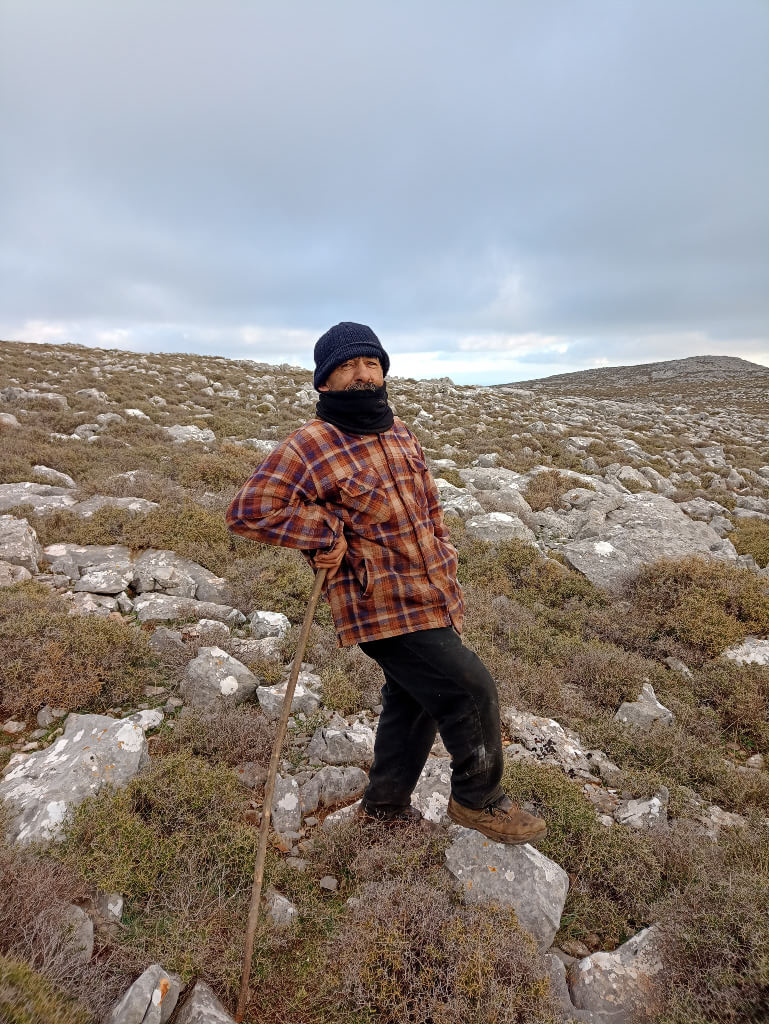
📷 The shepherd Yannis Boulas
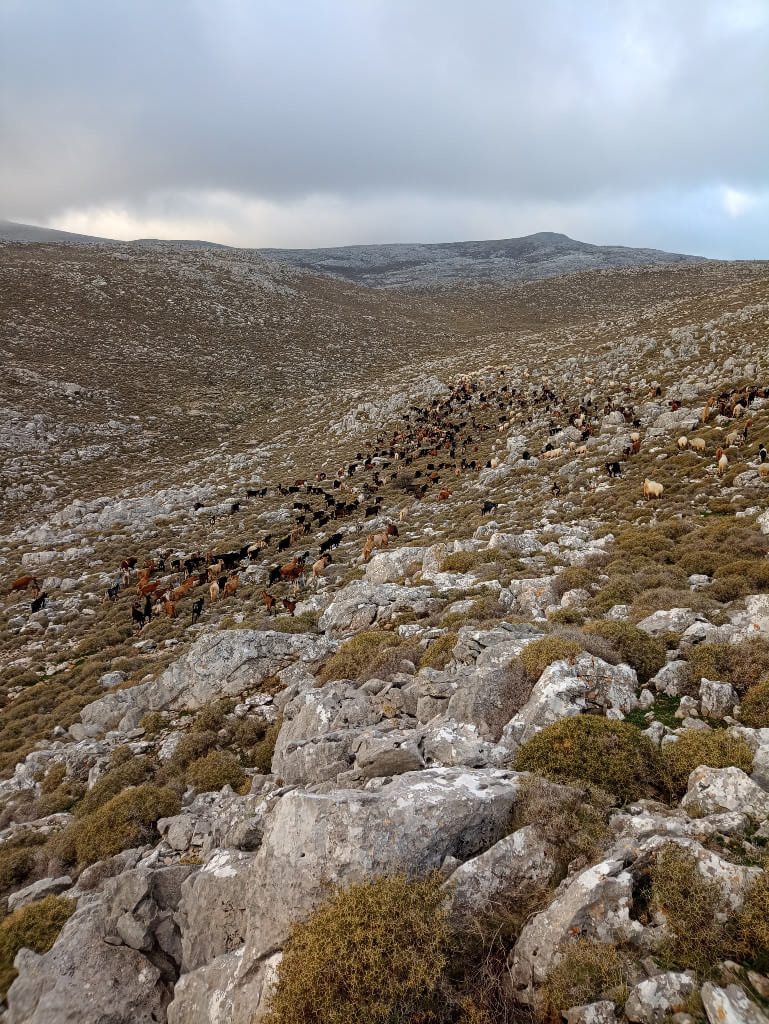
📷 The flock climbing towards Rou
I follow the flock, trying to understand what’s going on and if I can help. Everything happens quickly; the animals are rested and move fast. We cross the main road and climb up towards Polyrizo. Some goats stray, and I run to bring them back. One, however, refuses to comply and insists on taking a detour towards Lagkadi. I realize I’ll hardly manage to catch it and nod to Elias. In seconds, he approaches it, but the goat doesn’t cooperate, so he’s forced to take it back to the sheepfold to transport it later by car. “Something’s wrong with it, maybe it’s hurting somewhere. It’s not just tiredness that’s making it not want to move,” Yiannis explains to me.
At Kakopetria, we bid farewell to Yiannis. “Have a good journey,” he shouts after us. He’ll return and come find us at Fa in the afternoon by car, along with a cousin, to transport bedding and other supplies to the hut where the two brothers will spend the night. We continue towards Rou, and gradually, I realize that our path isn’t always on a trail – or at least not an obvious one. Elias tells me about the local place names, and I observe the animals. The sheep, one behind the other, lead the way, while the flock of goats follows.
I follow the flock, trying to understand what’s going on and if I can help. Everything happens quickly; the animals are rested and move fast. We cross the main road and climb up towards Polyrizo. Some goats stray, and I run to bring them back. One, however, refuses to comply and insists on taking a detour towards Lagkadi. I realize I’ll hardly manage to catch it and nod to Elias. In seconds, he approaches it, but the goat doesn’t cooperate, so he’s forced to take it back to the sheepfold to transport it later by car. “Something’s wrong with it, maybe it’s hurting somewhere. It’s not just tiredness that’s making it not want to move,” Yiannis explains to me.
At Kakopetria, we bid farewell to Yiannis. “Have a good journey,” he shouts after us. He’ll return and come find us at Fa in the afternoon by car, along with a cousin, to transport bedding and other supplies to the hut where the two brothers will spend the night. We continue towards Rou, and gradually, I realize that our path isn’t always on a trail – or at least not an obvious one. Elias tells me about the local place names, and I observe the animals. The sheep, one behind the other, lead the way, while the flock of goats follows.
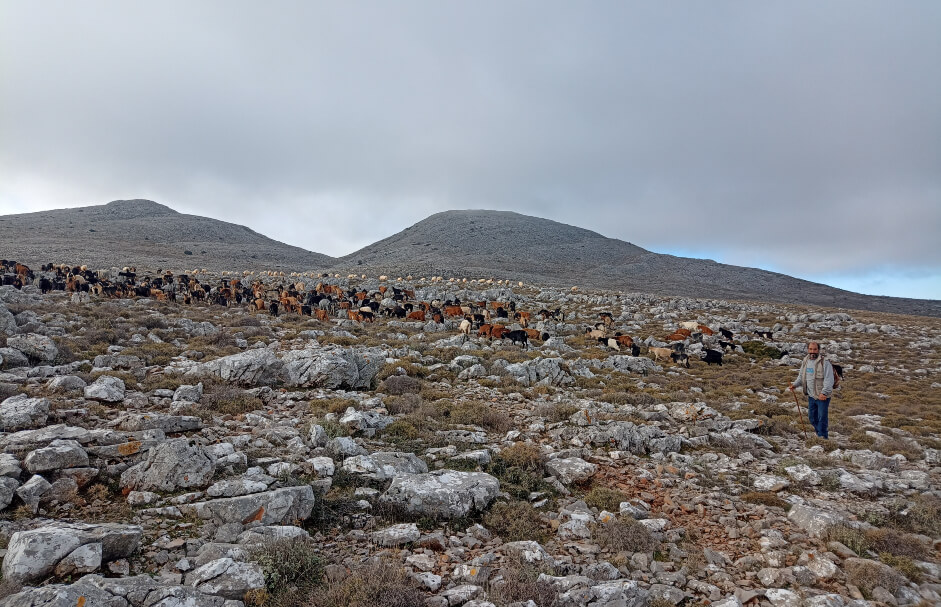
📷 Elias and the flock
Near Katevato, we take the lead, and Vassilis stays behind with the dogs. We climb up towards Choraftitsi. Elias asks me to slow down so the goats don’t get winded. “Which ones can handle it better?” I ask. “Sheep have more stamina, but when they sit down, that’s it – they’re exhausted. Goats, on the other hand, warn you when they’re running out of energy.“
We continue towards Arvanitissa. Five or six stray goats are ahead of us. Elias runs to chase them away so they don’t mix with ours. We’re moving at a high elevation, on the rough terrain below Apangellia, and the view is beautiful. Soon, however, we plunge into the pine forest and struggle to move forward, pushing aside branches. “The old-timers were heroes,” Elias says. “They’d walk and prune, opening up the paths.” We finally emerge from the dense forest. Elias points out a trail and says, “This is where the shepherds from Pitios used to come down.”
Near Katevato, we take the lead, and Vassilis stays behind with the dogs. We climb up towards Choraftitsi. Elias asks me to slow down so the goats don’t get winded. “Which ones can handle it better?” I ask. “Sheep have more stamina, but when they sit down, that’s it – they’re exhausted. Goats, on the other hand, warn you when they’re running out of energy.“
We continue towards Arvanitissa. Five or six stray goats are ahead of us. Elias runs to chase them away so they don’t mix with ours. We’re moving at a high elevation, on the rough terrain below Apangellia, and the view is beautiful. Soon, however, we plunge into the pine forest and struggle to move forward, pushing aside branches. “The old-timers were heroes,” Elias says. “They’d walk and prune, opening up the paths.” We finally emerge from the dense forest. Elias points out a trail and says, “This is where the shepherds from Pitios used to come down.”
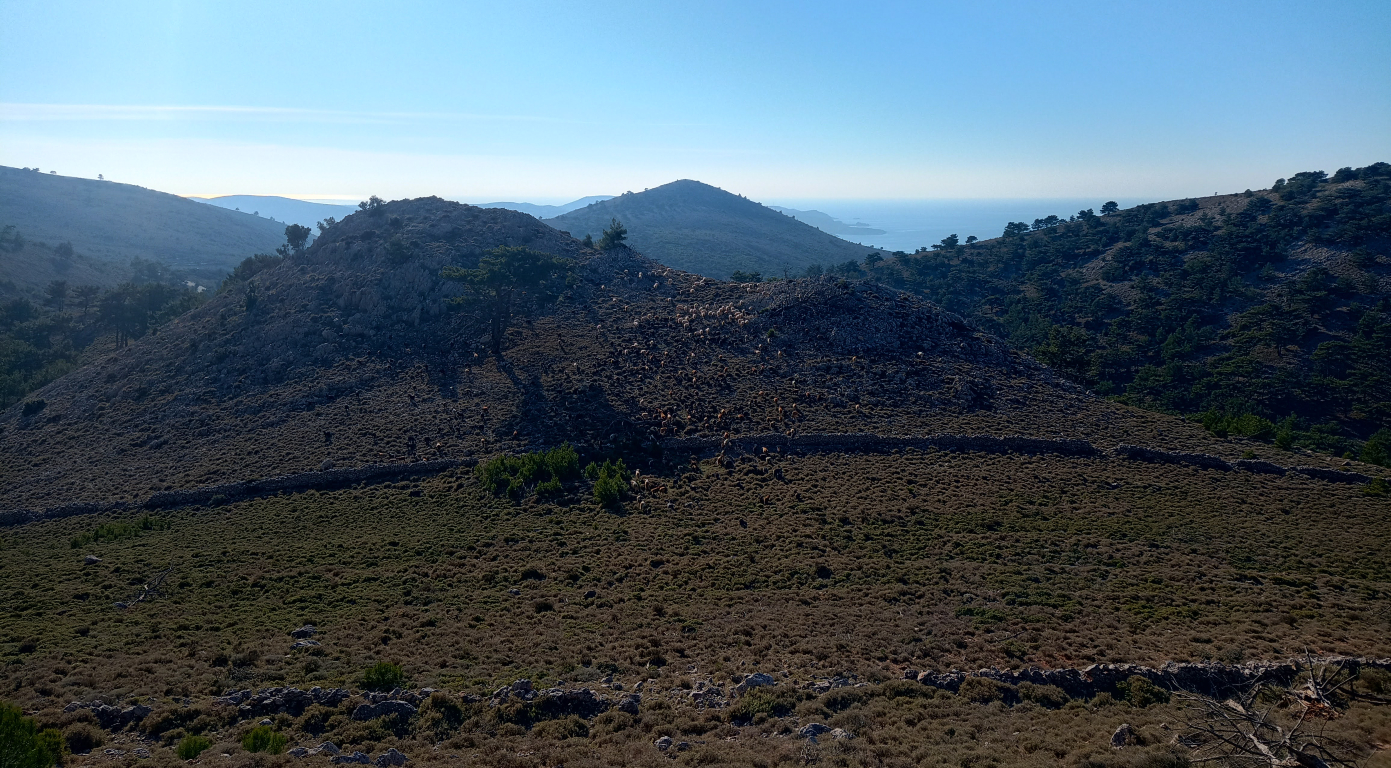
📷 The long, narrow field enclosed by dry stone walls, southwest of the Voukrano hill
We stop at Platanaki for the animals to quench their thirst at the stagnant waters. Then, we take an “interesting” path that offers us an unobstructed view of Anavatos and the western coastline of Chios. Just before the pass of Provatas, we encounter beehives, so for safety’s sake, we steer the goats and sheep a bit further out. We cross the main road perpendicularly and climb up a dirt road west of Provatas. “There used to be a path here, but the army came and built a road,” Elias tells me.
We cross the “seat” of Alonos and continue on the western slope of Voukranos. Everything is going smoothly, as we’re just a few kilometers away from the end of the first day. Suddenly, however, the alarm sounds: Vassilis notices that a goat is about to give birth. They’re worried that she might start labor before we reach Fa. We continue on our way, and soon the animals pass through an impressive, long curve. The sunlight falls on the leading sheep, making them shine.
We stop at Platanaki for the animals to quench their thirst at the stagnant waters. Then, we take an “interesting” path that offers us an unobstructed view of Anavatos and the western coastline of Chios. Just before the pass of Provatas, we encounter beehives, so for safety’s sake, we steer the goats and sheep a bit further out. We cross the main road perpendicularly and climb up a dirt road west of Provatas. “There used to be a path here, but the army came and built a road,” Elias tells me.
We cross the “seat” of Alonos and continue on the western slope of Voukranos. Everything is going smoothly, as we’re just a few kilometers away from the end of the first day. Suddenly, however, the alarm sounds: Vassilis notices that a goat is about to give birth. They’re worried that she might start labor before we reach Fa. We continue on our way, and soon the animals pass through an impressive, long curve. The sunlight falls on the leading sheep, making them shine.
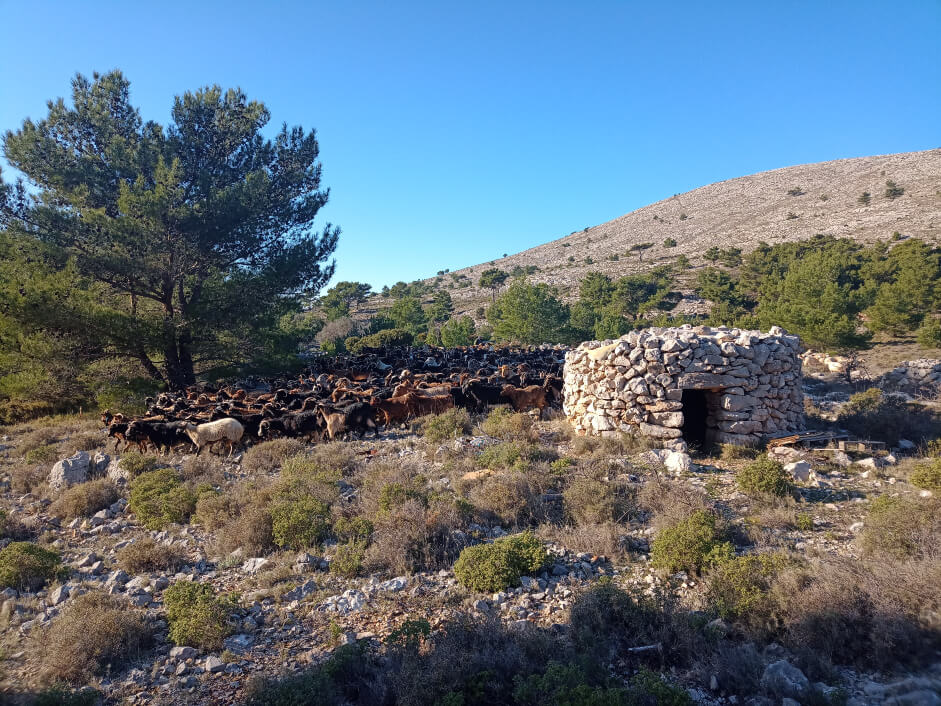
📷 The goats and sheep next to the hut where the shepherds spent the night in Fa
We arrive at Fa, where Giannis and their cousin are waiting for us. Vassilis and Elias start searching for the goat about to give birth, but without success. Vassilis oversees the hungry animals grazing in the abandoned fields, while Elias heads back to track her down. And indeed, after a while, he appears, holding the goat and her newborn kid.
We carry the supplies from the car to the stone-built hut that will house them for the night, and then we drive the animals to the fountain and the enclosure they’ve set up with stakes and wire mesh to pen them in. I part ways with Fa along with Giannis and their cousin, scheduling a meeting for the next morning to continue our journey to Mesta.
We arrive at Fa, where Giannis and their cousin are waiting for us. Vassilis and Elias start searching for the goat about to give birth, but without success. Vassilis oversees the hungry animals grazing in the abandoned fields, while Elias heads back to track her down. And indeed, after a while, he appears, holding the goat and her newborn kid.
We carry the supplies from the car to the stone-built hut that will house them for the night, and then we drive the animals to the fountain and the enclosure they’ve set up with stakes and wire mesh to pen them in. I part ways with Fa along with Giannis and their cousin, scheduling a meeting for the next morning to continue our journey to Mesta.
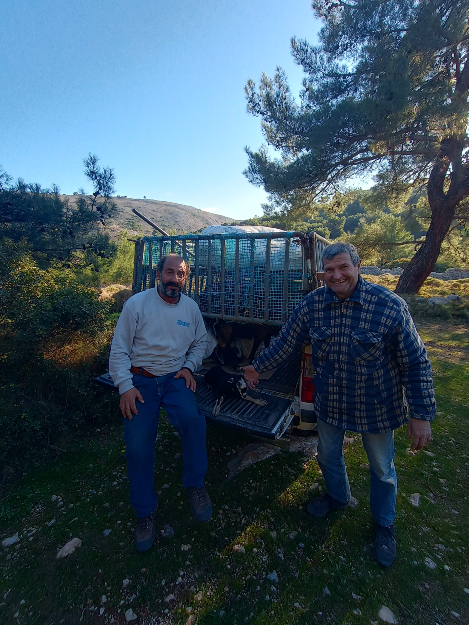
📷 Εlias, their cousin, and the newborn goat
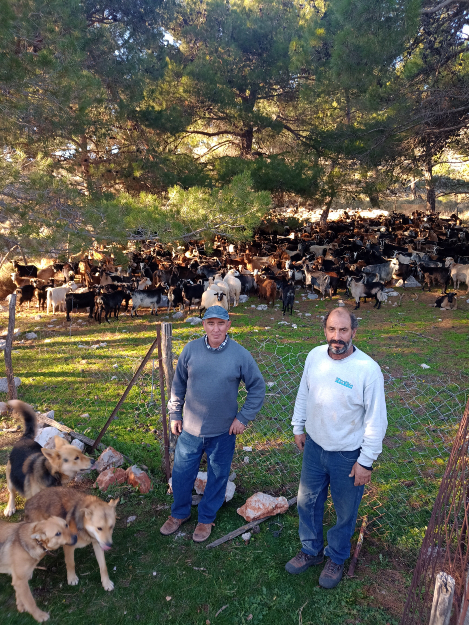
📷 Vasilis, Elias, and behind them, their animals fenced in at the Fa
It’s 6:45, still dark, when I arrive at Fa. Vassilis and Elias are organizing their belongings inside and outside the hut, to be collected by a relative later in the day. “Did you see any hunters’ cars? Did you hear the weather forecast?” they ask me. I notice a sense of worry – perhaps even irritation. The sky is heavy, and as we climb up the Lithi mountain, the rain breaks out. We ride over the hill and begin our descent. The smells of the animals and wet earth mix with those of the first mastic trees we encounter on our route.
Before we reach Apistia, I understand why the second day was causing concern for the two brothers. A hunter with his dog is moving through the area, and a bit further down, there are fields with olive trees and lentisk. The shepherds are on high alert – running, shouting, whistling, doing everything in their power to keep the animals from straying. As soon as we reach the main road, a car approaches from behind and waits patiently. However, the sheep get confused and start to wander off. The two brothers communicate amidst the rain and tension. Elias runs to bring them back to the “right path,” and we follow with the goats. Elias catches up to the sheep and brings them back. Humans and animals alike make our way down to the ravine and then clamber up towards Chalkomatou and Katoros.
It’s 6:45, still dark, when I arrive at Fa. Vassilis and Elias are organizing their belongings inside and outside the hut, to be collected by a relative later in the day. “Did you see any hunters’ cars? Did you hear the weather forecast?” they ask me. I notice a sense of worry – perhaps even irritation. The sky is heavy, and as we climb up the Lithi mountain, the rain breaks out. We ride over the hill and begin our descent. The smells of the animals and wet earth mix with those of the first mastic trees we encounter on our route.
Before we reach Apistia, I understand why the second day was causing concern for the two brothers. A hunter with his dog is moving through the area, and a bit further down, there are fields with olive trees and lentisk. The shepherds are on high alert – running, shouting, whistling, doing everything in their power to keep the animals from straying. As soon as we reach the main road, a car approaches from behind and waits patiently. However, the sheep get confused and start to wander off. The two brothers communicate amidst the rain and tension. Elias runs to bring them back to the “right path,” and we follow with the goats. Elias catches up to the sheep and brings them back. Humans and animals alike make our way down to the ravine and then clamber up towards Chalkomatou and Katoros.
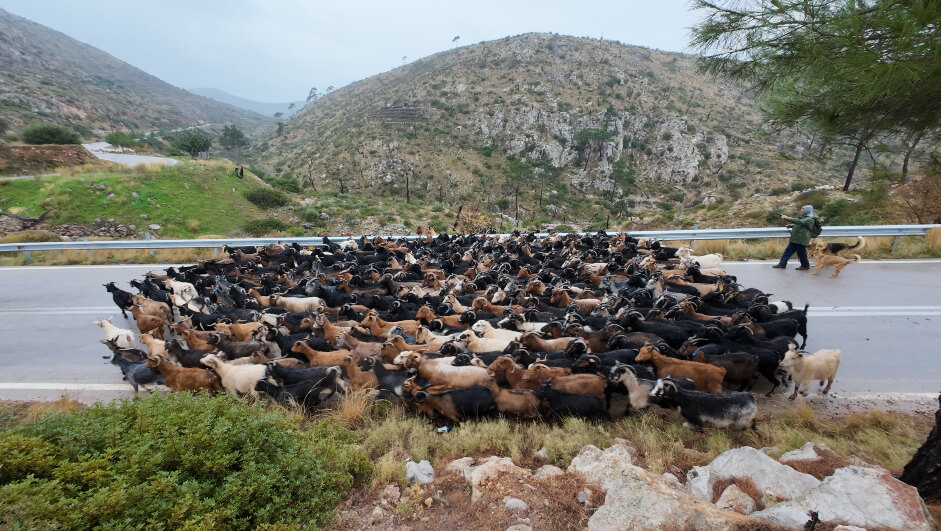
📷 Vassilis with the goats at Apistia, while in the background to the left, the stray sheep can just barely be seen
At Skafi, Vassilis, a friend of theirs, a sturdy man and a stonemason, who looks just like Nikolas Papazoglou, catches up with us in his truck. The other Vassilis takes the car and heads to Agia Eirini, where we’ll arrive after a while. We walk with a view of Agios Stefanos, Mikro Nisi, and Pelagonisi. Elias asks me to go ahead and gather the sheep. I run downhill and catch up to them just before Kokkina. I’m not sure if I can handle them, but slowly – with shouts and gestures – I find a way to get them in order and, like a shepherd, lead them for 1-2 kilometers until Agia Eirini. It seems a bit funny to me, but I enjoy it.
From Agia Eirini to our final destination, the two shepherds take turns driving the truck behind us. Three times, with lightning-fast movements, Elias caught goats that showed signs of exhaustion and loaded them onto the truck. As impressive as his ability to pick them out from the crowd was, his skill in catching them was equally astonishing. He also caught a goat about to give birth and put her in the truck too. Unfortunately, however, she miscarried. These things happen.
At Skafi, Vassilis, a friend of theirs, a sturdy man and a stonemason, who looks just like Nikolas Papazoglou, catches up with us in his truck. The other Vassilis takes the car and heads to Agia Eirini, where we’ll arrive after a while. We walk with a view of Agios Stefanos, Mikro Nisi, and Pelagonisi. Elias asks me to go ahead and gather the sheep. I run downhill and catch up to them just before Kokkina. I’m not sure if I can handle them, but slowly – with shouts and gestures – I find a way to get them in order and, like a shepherd, lead them for 1-2 kilometers until Agia Eirini. It seems a bit funny to me, but I enjoy it.
From Agia Eirini to our final destination, the two shepherds take turns driving the truck behind us. Three times, with lightning-fast movements, Elias caught goats that showed signs of exhaustion and loaded them onto the truck. As impressive as his ability to pick them out from the crowd was, his skill in catching them was equally astonishing. He also caught a goat about to give birth and put her in the truck too. Unfortunately, however, she miscarried. These things happen.
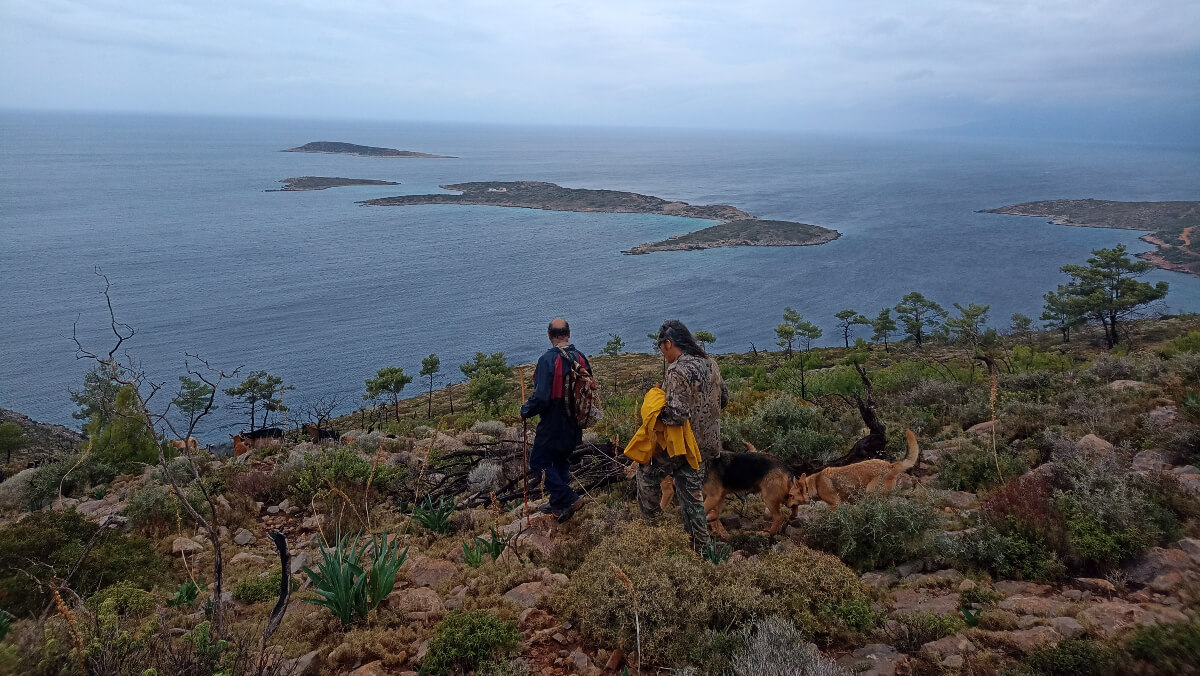
📷 Elias and Vassilis from Lithi, with Agios Stefanow, Pelagonisi and the Small Island in the background
Just before we reach Potamos, Elias signals us to speed up. The two brothers have changed their minds and instead of spending the night outside Mesta, they’ll do their best to reach Petasos the same day. We’ve been moving faster than they expected, as the morning rain didn’t give the animals much room to dawdle, and there’s also a chance of bad weather the next day. I feel tired, but also happy. The change of plans allows me to continue with the shepherds to their pen and complete the journey. On the way, we meet Aristarchos, who offers us oranges.
We arrive at the port of Mesta and pick up the pace. The presence of so many animals in a residential area poses risks, and the last thing the shepherds want is trouble with the locals. People come to their windows, greet us, take photos and videos. At the end of the harbor, the sheep – accustomed from previous years – turn right towards the Vigla. However, the shepherds have decided this year to go via the main road, and they need gestures, shouts, and whistles to convince them to take the unfamiliar road. Outside one of the last houses in the harbor, a woman greets us, makes the sign of the cross, and shouts: “May they be blessed.”
Just before we reach Potamos, Elias signals us to speed up. The two brothers have changed their minds and instead of spending the night outside Mesta, they’ll do their best to reach Petasos the same day. We’ve been moving faster than they expected, as the morning rain didn’t give the animals much room to dawdle, and there’s also a chance of bad weather the next day. I feel tired, but also happy. The change of plans allows me to continue with the shepherds to their pen and complete the journey. On the way, we meet Aristarchos, who offers us oranges.
We arrive at the port of Mesta and pick up the pace. The presence of so many animals in a residential area poses risks, and the last thing the shepherds want is trouble with the locals. People come to their windows, greet us, take photos and videos. At the end of the harbor, the sheep – accustomed from previous years – turn right towards the Vigla. However, the shepherds have decided this year to go via the main road, and they need gestures, shouts, and whistles to convince them to take the unfamiliar road. Outside one of the last houses in the harbor, a woman greets us, makes the sign of the cross, and shouts: “May they be blessed.”
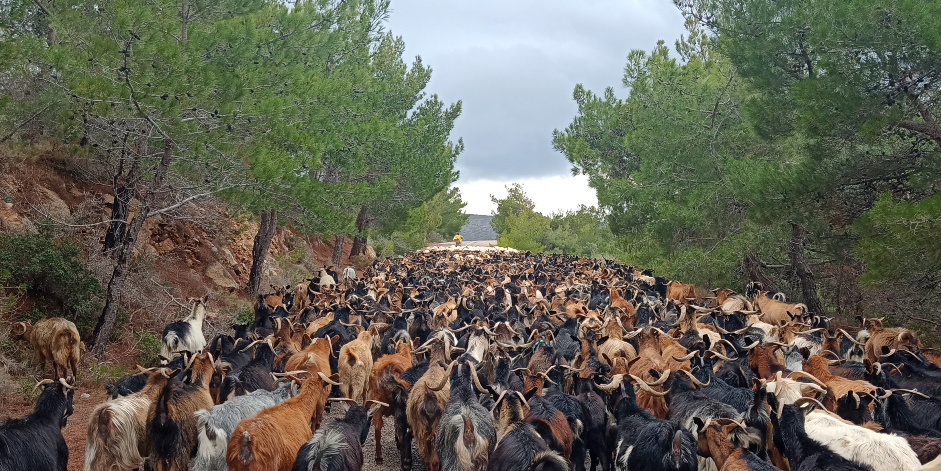
📷 Vassilis from Lithi leading the flock near Potami
We pass outside Mesta and turn towards Apothika. The goats and sheep, wherever they find scrub or grass, rush to eat. They’re tired now, and our pace has slowed. After Strongylovouno, we leave the asphalt and turn west. We cross dirt roads, paths, fields, and a beautiful ravine. We ride over Kasiovouni, and finally, we catch sight of the large pen of Petasos. We’ve almost arrived, and then, suddenly, the shepherd’s dog – who hadn’t taken a liking to me from the start – comes behind me and bites me on the leg! Of all the times… After so many hours, after so many kilometers! The marks from the dog’s teeth are clear; my leg starts bleeding immediately.
We arrive at the pen after approximately 45 kilometers of hiking. The goats enter the stable, and the sheep roam around outside. There’s fatigue, but also a sense of satisfaction, as the demanding mission was completed successfully. The Kazaglia brothers and their animals will spend the winter there, and at the end of March, they’ll follow the opposite route to return to Aepos. We take a few commemorative photos, I thank them for taking me along, and I bid them farewell. We leave in Vassilis’ car. By the time we reach Fa, it’s fully dark. A thick fog has fallen over Provatas.
We pass outside Mesta and turn towards Apothika. The goats and sheep, wherever they find scrub or grass, rush to eat. They’re tired now, and our pace has slowed. After Strongylovouno, we leave the asphalt and turn west. We cross dirt roads, paths, fields, and a beautiful ravine. We ride over Kasiovouni, and finally, we catch sight of the large pen of Petasos. We’ve almost arrived, and then, suddenly, the shepherd’s dog – who hadn’t taken a liking to me from the start – comes behind me and bites me on the leg! Of all the times… After so many hours, after so many kilometers! The marks from the dog’s teeth are clear; my leg starts bleeding immediately.
We arrive at the pen after approximately 45 kilometers of hiking. The goats enter the stable, and the sheep roam around outside. There’s fatigue, but also a sense of satisfaction, as the demanding mission was completed successfully. The Kazaglia brothers and their animals will spend the winter there, and at the end of March, they’ll follow the opposite route to return to Aepos. We take a few commemorative photos, I thank them for taking me along, and I bid them farewell. We leave in Vassilis’ car. By the time we reach Fa, it’s fully dark. A thick fog has fallen over Provatas.
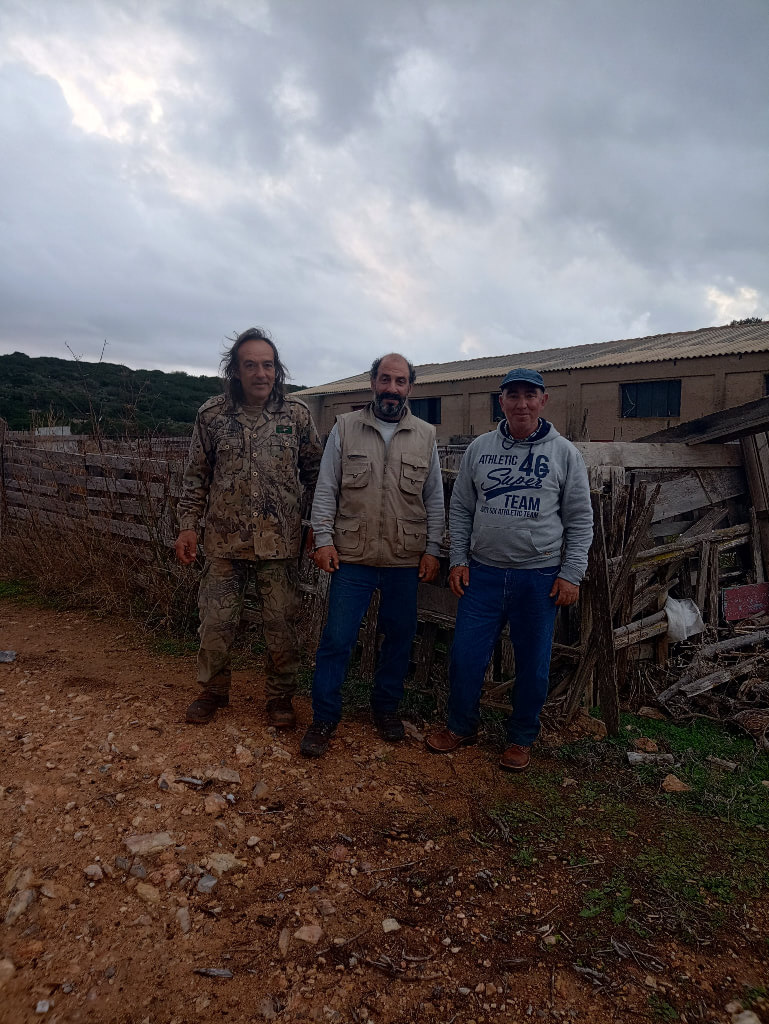
📷 Vassilis and the Kazaglia brothers at their sheepfold in Petasos
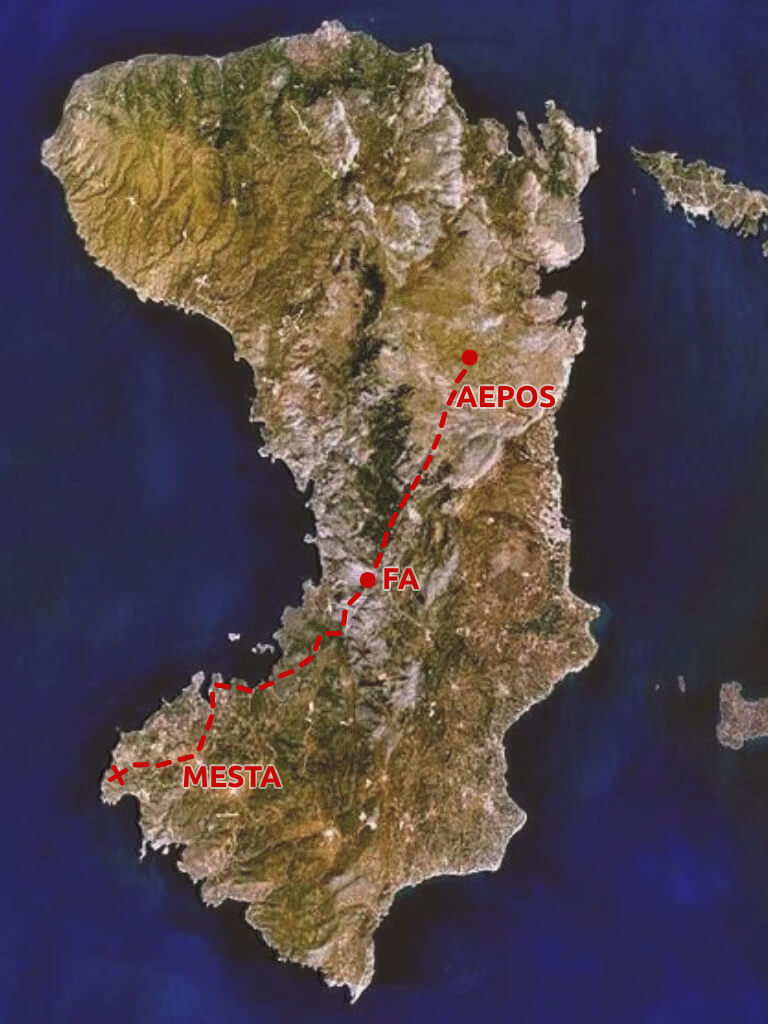
📷 Indicative mapping of the route