
STORIES, MYTHS AND LEGENDS
OF HIDDEN TREASURES IN PITIOS
Around Pitios, many old settlements, wells, and caves are linked to stories of buried treasures. From Aria and Fardi Pigadi (meaning Broad Well) to Flori and Yemelika, numerous sites around the village have—and not without reason—a reputation for once hiding gold. When the Genoese abandoned Pitios, they are said to have buried their riches. The same is told of the Turks later on. Fearing pirate raids, the locals would hide their jewelry, and during the German Occupation, some who fled as refugees to the Middle East buried their valuables before leaving.
Over the years, Pitios and its surrounding area have become steeped in stories of hidden treasures and legends that fade into the depths of time. Tales of gold coins, royal riches, and well-kept secrets have long fueled the imagination of locals—as well as the curiosity of ambitious treasure hunters who, even today, wander the area with metal detectors or shovels, hoping to uncover the lost gold.
“Just like we take our money to the bank nowadays, back then they took it to Papa-Listis (meaning Priest-Bandit),” recounted seventy-seven-year-old Argiris Liovaris, sharing an old—almost forgotten—story he had once heard from old Panagiotis Mithris. “Papa-Listis was a specialist, and everyone knew him. He would send out the town crier, walking through the village shouting, ‘Tomorrow I’ll go hide the money!’ He had to fast for forty days, then they would count and record the money, and all go together to bury it—because the Saracens would come, killing, looting, and loading the ships.”
Around Pitios, many old settlements, wells, and caves are linked to stories of buried treasures. From Aria and Fardi Pigadi (meaning Broad Well) to Flori and Yemelika, numerous sites around the village have—and not without reason—a reputation for once hiding gold. When the Genoese abandoned Pitios, they are said to have buried their riches. The same is told of the Turks later on. Fearing pirate raids, the locals would hide their jewelry, and during the German Occupation, some who fled as refugees to the Middle East buried their valuables before leaving.
Over the years, Pitios and its surrounding area have become steeped in stories of hidden treasures and legends that fade into the depths of time. Tales of gold coins, royal riches, and well-kept secrets have long fueled the imagination of locals—as well as the curiosity of ambitious treasure hunters who, even today, wander the area with metal detectors or shovels, hoping to uncover the lost gold.
“Just like we take our money to the bank nowadays, back then they took it to Papa-Listis (meaning Priest-Bandit),” recounted seventy-seven-year-old Argiris Liovaris, sharing an old—almost forgotten—story he had once heard from old Panagiotis Mithris. “Papa-Listis was a specialist, and everyone knew him. He would send out the town crier, walking through the village shouting, ‘Tomorrow I’ll go hide the money!’ He had to fast for forty days, then they would count and record the money, and all go together to bury it—because the Saracens would come, killing, looting, and loading the ships.”
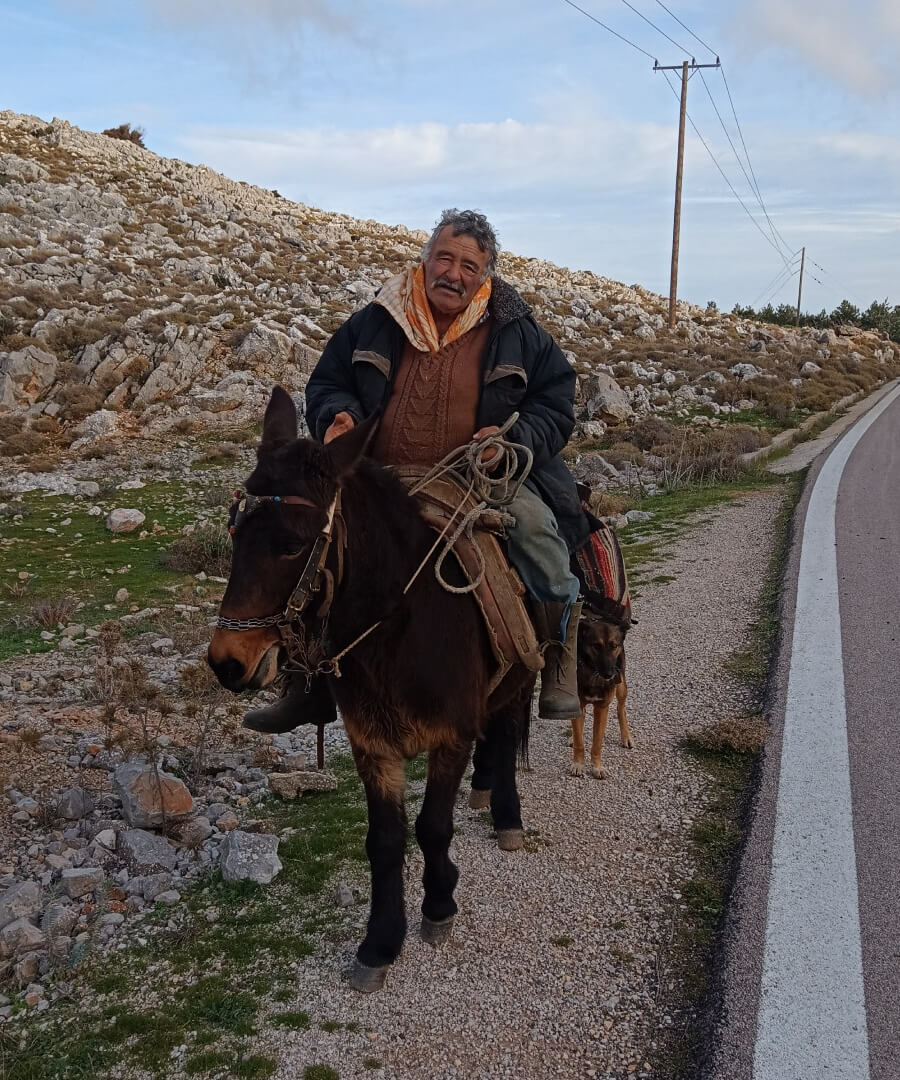
📷 Argiris Liovaris near his animal pen at the location “Kritikou Lakkos.”
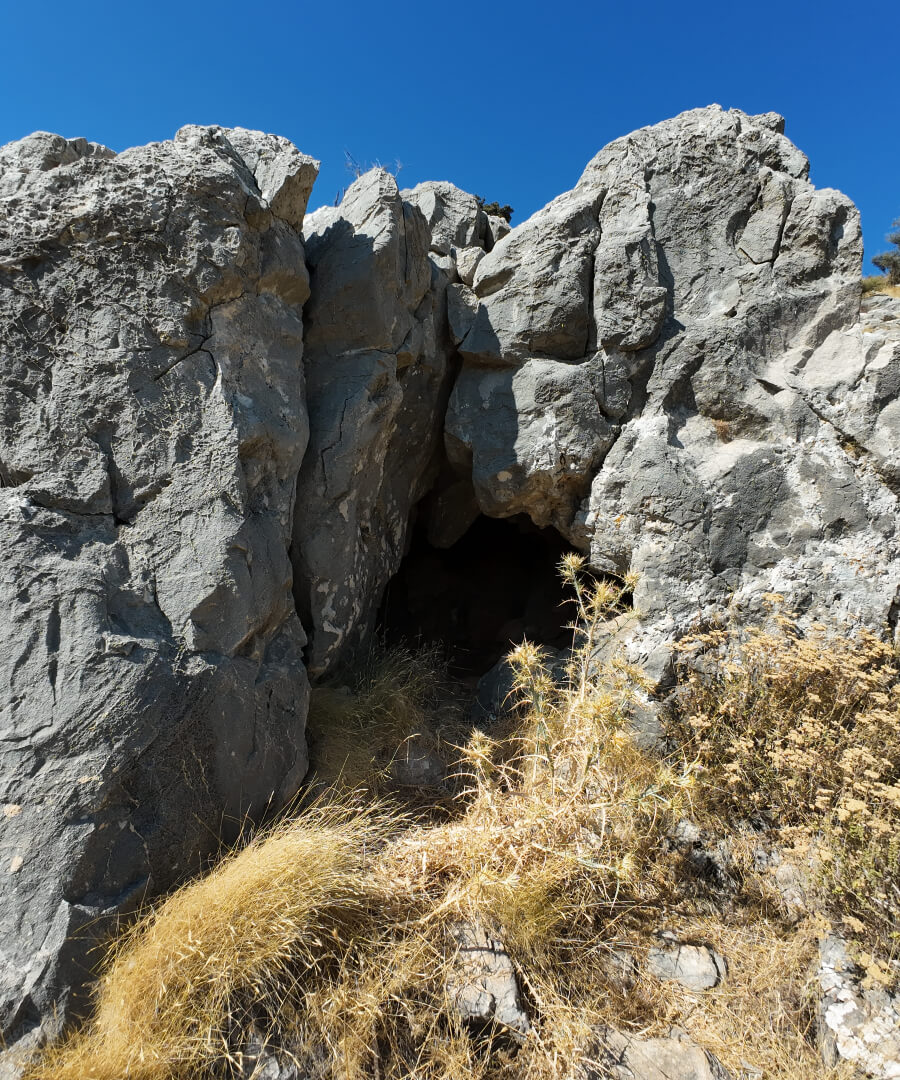
📷 The rock cave at Yemelika, in the area of Pitsarika.
“Since everyone knew where the money was hidden, why didn’t anyone steal it?” I asked. “It was proven that whoever tried wouldn’t survive,” he replied. “Papa-Listis had read psalm curses—everyone in the village feared them. To retrieve the money, Papa-Listis had to fast another forty days, and then they all went together to the hiding places”. There he would recite special prayers, and only then could the buried money be safely returned to its owners.
“But those priests died, and the hidden money remained—but out of fear, no one ever touched it,” Liovaris went on, offering his own explanation for the many buried treasures in the wider Pitios area. “Those treasures were the old banks,” he insisted, recounting stories of hidden wealth in Hamospilos Cave, at the chapel of Saint George Florianos, in Aria, and even in a small cave at Yemelika.
Not far from there, his in-laws owned a few olive trees. One day, his mother-in-law took shelter in a small cave during a heavy downpour and noticed a patch of cement at its entrance. She suspected something might be hidden there and told her husband about it. At first, he didn’t believe her—but as he thought it over, he made the mistake of mentioning it that evening to his fellow villagers at the coffeehouse. The next morning, he grabbed a pickaxe and went to dig at the cave. But when he arrived, the entrance had already been dug up…
The stories about hidden money don’t end there. Another well-known treasure was said to be buried at Aria. Giannaros Apostolis, grandfather of Argiris Liovaris, kept a small livestock pen there. His grandson, today’s baker of Pitios, Yiannis Apostolis, recalls: “At the little well in Aria there was a flat stone. People would step on it to draw water with the sikla (a bucket on a rope) and water their goats. The stone would rock slightly, and my grandfather often wedged a small pebble underneath to steady it. But no one ever dared lift it. Beneath it was the treasure.” One night, however, a few fearless men went and lifted the stone—and found the hidden coins. Perhaps to ease their conscience, they left three Turkish coins on top of the slab for the spirits of the place.
“Since everyone knew where the money was hidden, why didn’t anyone steal it?” I asked. “It was proven that whoever tried wouldn’t survive,” he replied. “Papa-Listis had read psalm curses—everyone in the village feared them. To retrieve the money, Papa-Listis had to fast another forty days, and then they all went together to the hiding places”. There he would recite special prayers, and only then could the buried money be safely returned to its owners.
“But those priests died, and the hidden money remained—but out of fear, no one ever touched it,” Liovaris went on, offering his own explanation for the many buried treasures in the wider Pitios area. “Those treasures were the old banks,” he insisted, recounting stories of hidden wealth in Hamospilos Cave, at the chapel of Saint George Florianos, in Aria, and even in a small cave at Yemelika.
Not far from there, his in-laws owned a few olive trees. One day, his mother-in-law took shelter in a small cave during a heavy downpour and noticed a patch of cement at its entrance. She suspected something might be hidden there and told her husband about it. At first, he didn’t believe her—but as he thought it over, he made the mistake of mentioning it that evening to his fellow villagers at the coffeehouse. The next morning, he grabbed a pickaxe and went to dig at the cave. But when he arrived, the entrance had already been dug up…
The stories about hidden money don’t end there. Another well-known treasure was said to be buried at Aria. Giannaros Apostolis, grandfather of Argiris Liovaris, kept a small livestock pen there. His grandson, today’s baker of Pitios, Yiannis Apostolis, recalls: “At the little well in Aria there was a flat stone. People would step on it to draw water with the sikla (a bucket on a rope) and water their goats. The stone would rock slightly, and my grandfather often wedged a small pebble underneath to steady it. But no one ever dared lift it. Beneath it was the treasure.” One night, however, a few fearless men went and lifted the stone—and found the hidden coins. Perhaps to ease their conscience, they left three Turkish coins on top of the slab for the spirits of the place.
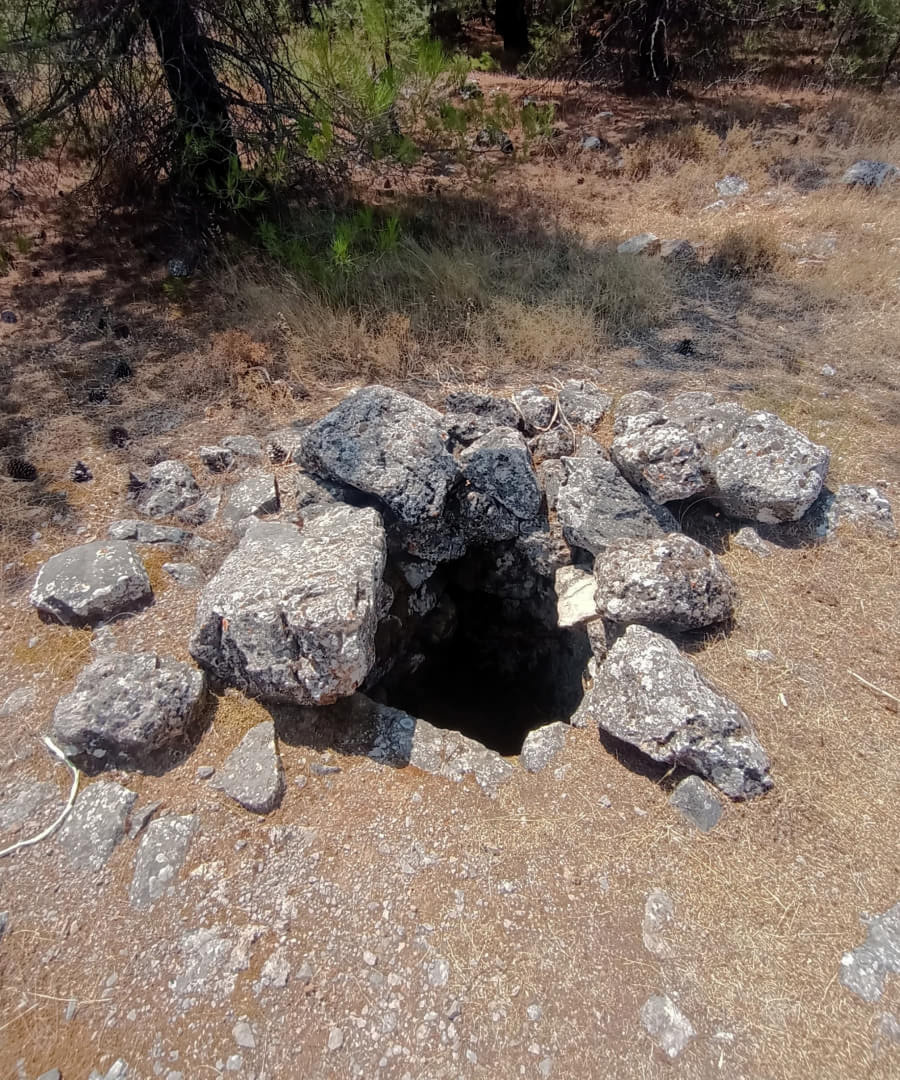
📷 The village well in the ancient agro-pastoral settlement of Aria.
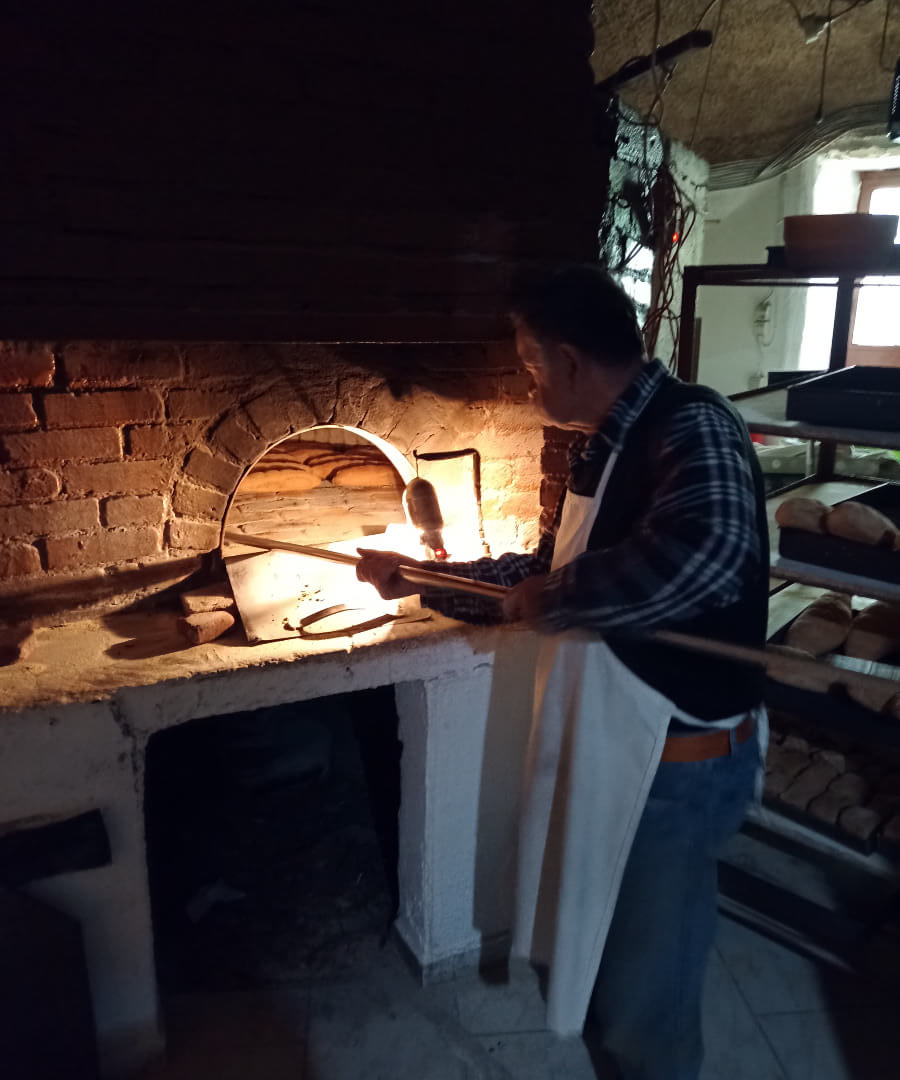
📷 Yiannis Apostolis, the emblematic baker of Pitios.
“When the Turks left Pitios, after the island’s liberation, some people believed they had left their treasure at Panagia Spiliotina,” added Yiannis Apostolis. “That’s why they tore down the old church—but they didn’t find any money.” Later, the people of Pitios built a new church a little higher up, and “then they went to Panagia Theotokina and dug all around. They found a few tiles, nothing important. But years later, when they decided to renovate the church and began work inside, that’s when they found the treasure.”
The large jar that once held the gold sovereigns from Panagia Theotokina has now been moved to the center of the village. It may be a common secret that “there was gold in Pitios,” but there were also cases where the buried jars contained not treasures or valuables, but the villagers’ agricultural goods. “They used to find jars buried in the gravel mounds, but they didn’t always hold gold coins—sometimes just hidden oil or wine, kept safe so the Turks wouldn’t seize them,” noted a housewife from Pityos.
“When the Turks left Pitios, after the island’s liberation, some people believed they had left their treasure at Panagia Spiliotina,” added Yiannis Apostolis. “That’s why they tore down the old church—but they didn’t find any money.” Later, the people of Pitios built a new church a little higher up, and “then they went to Panagia Theotokina and dug all around. They found a few tiles, nothing important. But years later, when they decided to renovate the church and began work inside, that’s when they found the treasure.”
The large jar that once held the gold sovereigns from Panagia Theotokina has now been moved to the center of the village. It may be a common secret that “there was gold in Pitios,” but there were also cases where the buried jars contained not treasures or valuables, but the villagers’ agricultural goods. “They used to find jars buried in the gravel mounds, but they didn’t always hold gold coins—sometimes just hidden oil or wine, kept safe so the Turks wouldn’t seize them,” noted a housewife from Pityos.
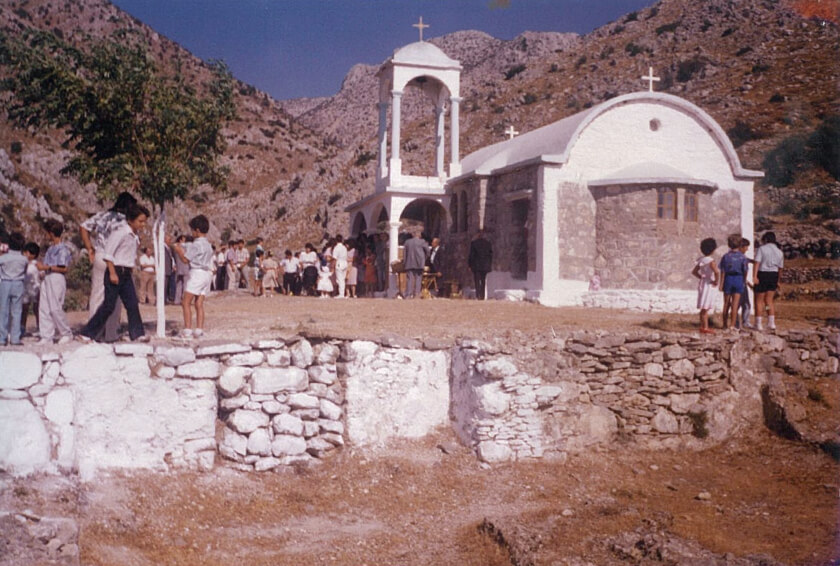
📷 Panagia Spiliotina. The wall of the old building is visible in front. Archive of Nikos Frangos.
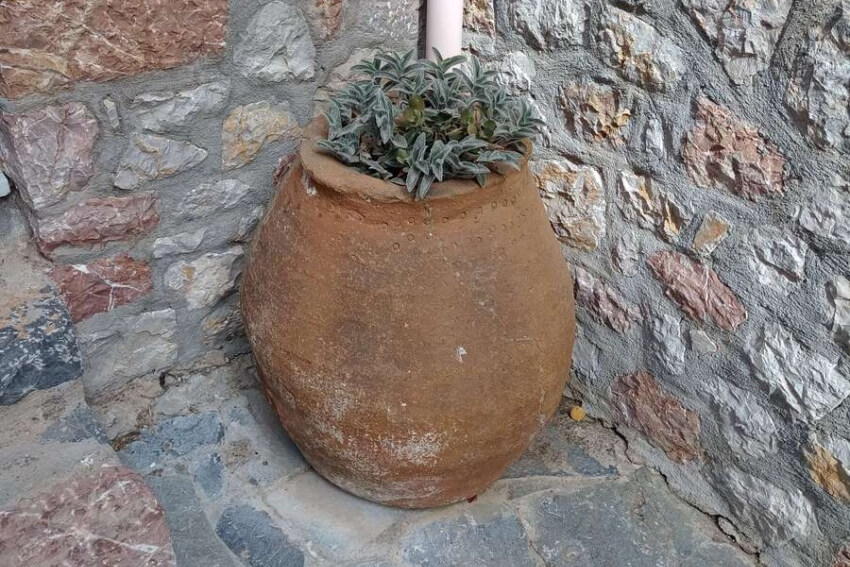
📷 The large jar from Panagia Theotokina, now kept in the center of the village.
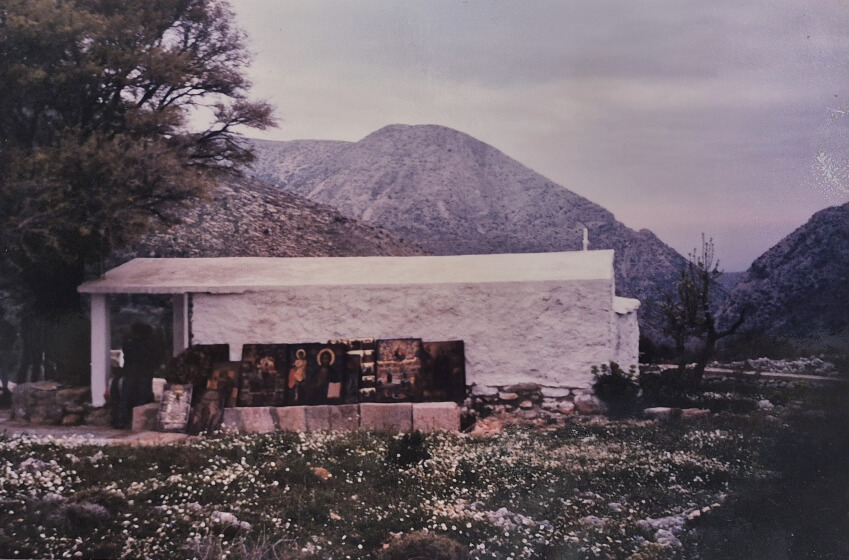
📷 Panagia Theotokina before its renovation. Archive of Nikos Frangos.
Undoubtedly, the area of Pitios most closely linked to tales of hidden treasures is the ancient agro-pastoral settlement of Fardi Pigadi—“Broad Well”—where, according to local tradition, once stood the kingdom of the Sunless King. The Sunless King, a Genoese lord of the area, was said to have survived a grave head injury by covering his skull with a wax cap. Unable to appear in daylight, as the sun would melt the wax and kill him, he lived hidden from the sun—hence his name. In 1961, the late Pityan schoolteacher Georgios Cheilas recorded in an article what his fellow villagers believed about Fardi Pigadi and its treasures. Even today, the older villagers still recall stories of “the sow with her twelve piglets,” “the queen’s golden spindle,” and, of course, the legendary emprostopisini chalikouria—the “front-facing gravel mound.” The fame of the buried treasures of Fardi Pigadi spread far beyond Pitios and Chios, even reaching abroad, attracting treasure hunters from other countries over the years!
Many residents of Pitios believed that gold was buried at Fardi Pigadi—not in the surrounding area, but in the well itself. This belief led local shepherds to dig it up, ultimately damaging the original structure. Later, in 1957, a water reservoir was built almost on the same spot during the presidency of Georgios Kourounis. Nothing of value was ever found at Fardi Pigadi, which is why some claim that the hidden treasure might actually lie in one of the other two wells in the area: Xeropigada (“Dry Well”) or another said to have been constructed by a Turk named Mahmoutis.
Nikos Kourounis, the 94-year-old son of Georgios Kourounis, wrote in 2020 about the enigmatic oracle of the “emprostopisini chalikouria” (the “front-facing gravel mound”) and noted the strong local belief that the “queen’s golden spindle” was hidden among the stone heaps of Fardi Pigadi. “From time to time, both locals and foreign visitors come to the area to dig through the gravel mounds. Some of the openings later observed by Pitios shepherds are thought to have once contained something.”
Undoubtedly, the area of Pitios most closely linked to tales of hidden treasures is the ancient agro-pastoral settlement of Fardi Pigadi—“Broad Well”—where, according to local tradition, once stood the kingdom of the Sunless King. The Sunless King, a Genoese lord of the area, was said to have survived a grave head injury by covering his skull with a wax cap. Unable to appear in daylight, as the sun would melt the wax and kill him, he lived hidden from the sun—hence his name. In 1961, the late Pityan schoolteacher Georgios Cheilas recorded in an article what his fellow villagers believed about Fardi Pigadi and its treasures. Even today, the older villagers still recall stories of “the sow with her twelve piglets,” “the queen’s golden spindle,” and, of course, the legendary emprostopisini chalikouria—the “front-facing gravel mound.” The fame of the buried treasures of Fardi Pigadi spread far beyond Pitios and Chios, even reaching abroad, attracting treasure hunters from other countries over the years!
Many residents of Pitios believed that gold was buried at Fardi Pigadi—not in the surrounding area, but in the well itself. This belief led local shepherds to dig it up, ultimately damaging the original structure. Later, in 1957, a water reservoir was built almost on the same spot during the presidency of Georgios Kourounis. Nothing of value was ever found at Fardi Pigadi, which is why some claim that the hidden treasure might actually lie in one of the other two wells in the area: Xeropigada (“Dry Well”) or another said to have been constructed by a Turk named Mahmoutis.
Nikos Kourounis, the 94-year-old son of Georgios Kourounis, wrote in 2020 about the enigmatic oracle of the “emprostopisini chalikouria” (the “front-facing gravel mound”) and noted the strong local belief that the “queen’s golden spindle” was hidden among the stone heaps of Fardi Pigadi. “From time to time, both locals and foreign visitors come to the area to dig through the gravel mounds. Some of the openings later observed by Pitios shepherds are thought to have once contained something.”
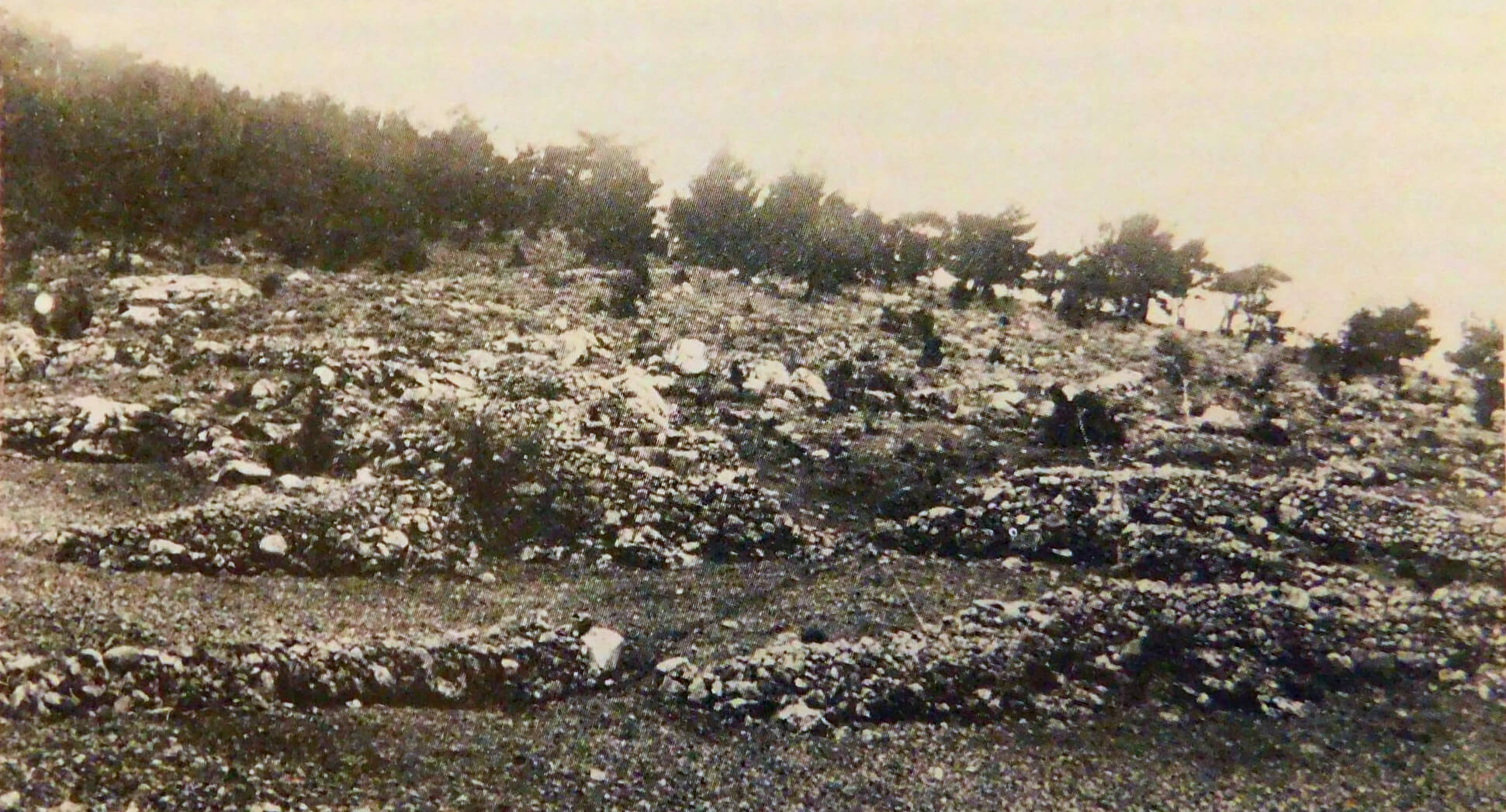
📷 Dry-stone structures at Fardi Pigadi. Benaki Museum Photographic Archive – Periklis Papachatzidakis (1912–1928).
Following the traces of these tales, we visited Fardi Pigadi together with 82-year-old Pantelis Mavrianos. Well-acquainted with the area, he guided me to the three wells and the three large stone mounds. “Sunrise, tip of the cypress, front-facing gravel mound,” he reminded me — the old oracle said to reveal the hiding place of Fardi Pigadi’s treasure. But which of the three mounds concealed the legendary hoard? Years ago, some shepherds from Pitios dug small holes in the middle mound, convinced it was the golden “emprostopisini chalikouria” — yet nothing of value was ever found. Today, there isn’t a single cypress left standing at Fardi Pigadi.
Some foreigners —“lords,” as the locals call them— seemed to have had better luck. They arrived around 1960 at the Kourounaina Café in Agios Sideros, where they met the then president of the community, Giorgos Kourounis, and asked him for directions to Fardi Pigadi. Kourounis asked a young shepherd boy, the late Kostis Mavrianos, to accompany them — and so he did. The next morning, when Kostis went up again to Fardi Pigadi to water his animals, he saw that the southern chalikouria (stone mound) had been dug open. As Liovaris told us, he vaguely remembered the empty jar lying beside the pile of stones. “The foreigners dug a little at the top of the mound and found a small jar full of coins, which they took. The mark remained visible for many years,” Apostolis added.
Following the traces of these tales, we visited Fardi Pigadi together with 82-year-old Pantelis Mavrianos. Well-acquainted with the area, he guided me to the three wells and the three large stone mounds. “Sunrise, tip of the cypress, front-facing gravel mound,” he reminded me — the old oracle said to reveal the hiding place of Fardi Pigadi’s treasure. But which of the three mounds concealed the legendary hoard? Years ago, some shepherds from Pitios dug small holes in the middle mound, convinced it was the golden “emprostopisini chalikouria” — yet nothing of value was ever found. Today, there isn’t a single cypress left standing at Fardi Pigadi.
Some foreigners —“lords,” as the locals call them— seemed to have had better luck. They arrived around 1960 at the Kourounaina Café in Agios Sideros, where they met the then president of the community, Giorgos Kourounis, and asked him for directions to Fardi Pigadi. Kourounis asked a young shepherd boy, the late Kostis Mavrianos, to accompany them — and so he did. The next morning, when Kostis went up again to Fardi Pigadi to water his animals, he saw that the southern chalikouria (stone mound) had been dug open. As Liovaris told us, he vaguely remembered the empty jar lying beside the pile of stones. “The foreigners dug a little at the top of the mound and found a small jar full of coins, which they took. The mark remained visible for many years,” Apostolis added.
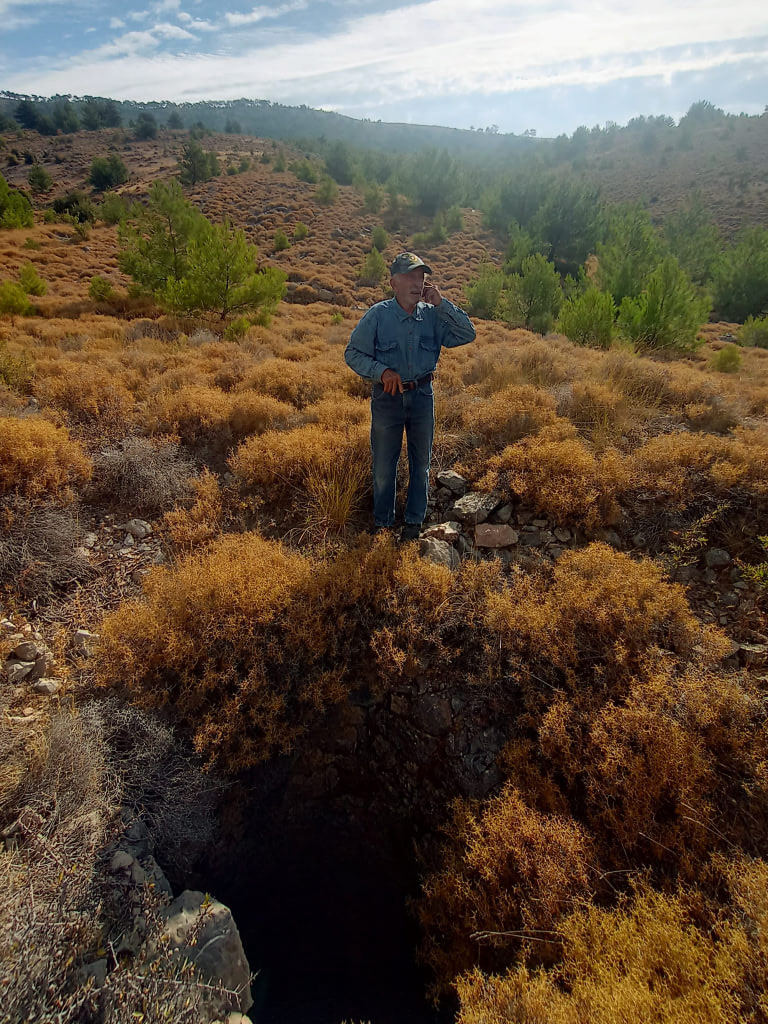
📷 Pantelis Mavrianos at Mahmoutis’ well.
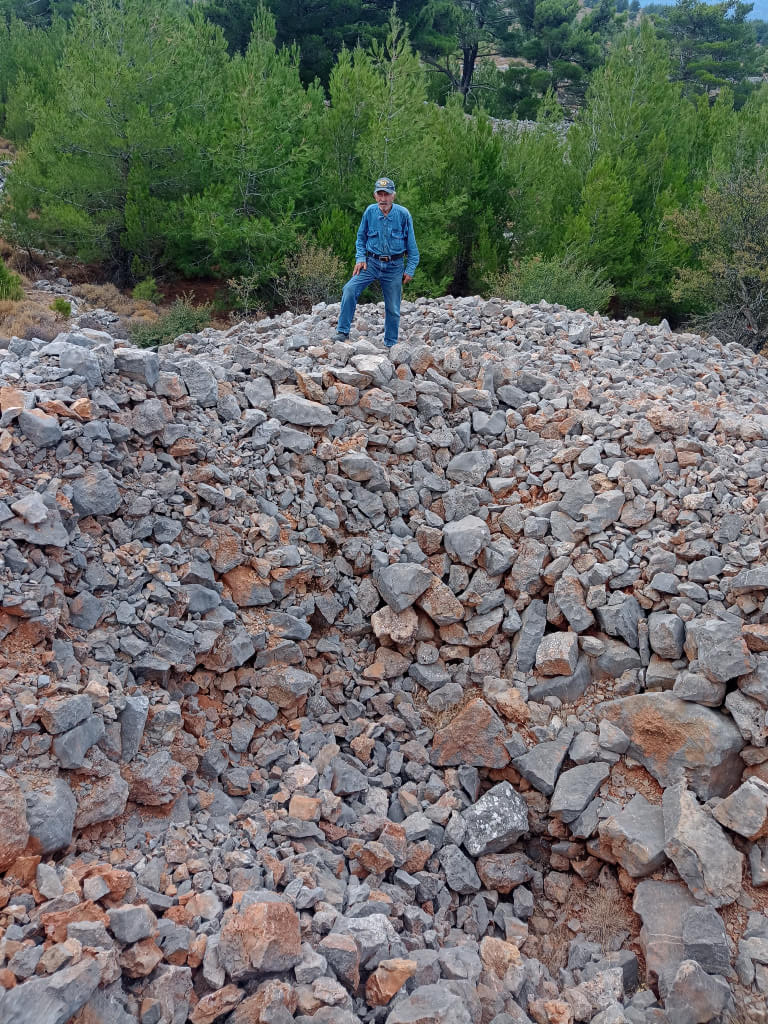
📷 Pantelis Mavrianos at the northern stone mound, which was dug open in 2010.
In early March 2010, the most recent and extensive illegal excavation took place in the area, targeting the northernmost of the three stone mounds — the only one that had remained untouched until then. Elias Mavrianos, brother of Kostis and Pantelis, kept his animal pen at Fardi Pigadi and one day noticed signs of digging at the chalikouria. “They must have been at it for several days — they even had a lookout posted at Giannaki,” said Anna Stratakia, the owner of the historic café in Agios Sideros.
The police were notified, and Elias volunteered to guide the officers to Fardi Pigadi along the trail that begins at Agios Sideros. “We set out almost at nightfall — there were five or six of us — it was a rainy winter evening,” Elias recalled. “No one would dare come up here in this weather,” he told them as they climbed. Indeed, when they reached Fardi Pigadi, they found the chalikouria dug all the way to the bottom and a few objects left behind — but not a single person in sight.
Much has been said about those illegal diggers. Some claim they were locals — even familiar faces from the area — while others insist they were foreign laborers who later left for Australia. Did they realize they had been discovered and stop digging out of fear, or had they already found the long-sought treasure and vanished from Fardi Pigadi for good?
In early March 2010, the most recent and extensive illegal excavation took place in the area, targeting the northernmost of the three stone mounds — the only one that had remained untouched until then. Elias Mavrianos, brother of Kostis and Pantelis, kept his animal pen at Fardi Pigadi and one day noticed signs of digging at the chalikouria. “They must have been at it for several days — they even had a lookout posted at Giannaki,” said Anna Stratakia, the owner of the historic café in Agios Sideros.
The police were notified, and Elias volunteered to guide the officers to Fardi Pigadi along the trail that begins at Agios Sideros. “We set out almost at nightfall — there were five or six of us — it was a rainy winter evening,” Elias recalled. “No one would dare come up here in this weather,” he told them as they climbed. Indeed, when they reached Fardi Pigadi, they found the chalikouria dug all the way to the bottom and a few objects left behind — but not a single person in sight.
Much has been said about those illegal diggers. Some claim they were locals — even familiar faces from the area — while others insist they were foreign laborers who later left for Australia. Did they realize they had been discovered and stop digging out of fear, or had they already found the long-sought treasure and vanished from Fardi Pigadi for good?
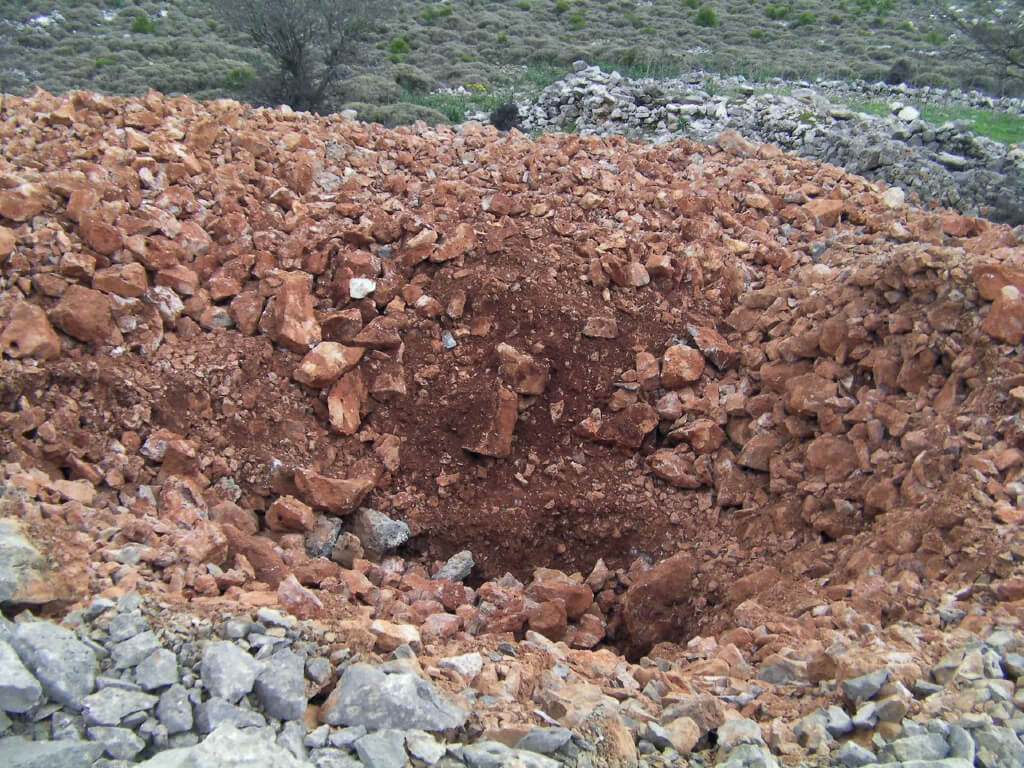
📷 The northern stone mound showing traces of recent digging (photo taken on 14 March 2010). Archive of Emmanouil Fyssas.
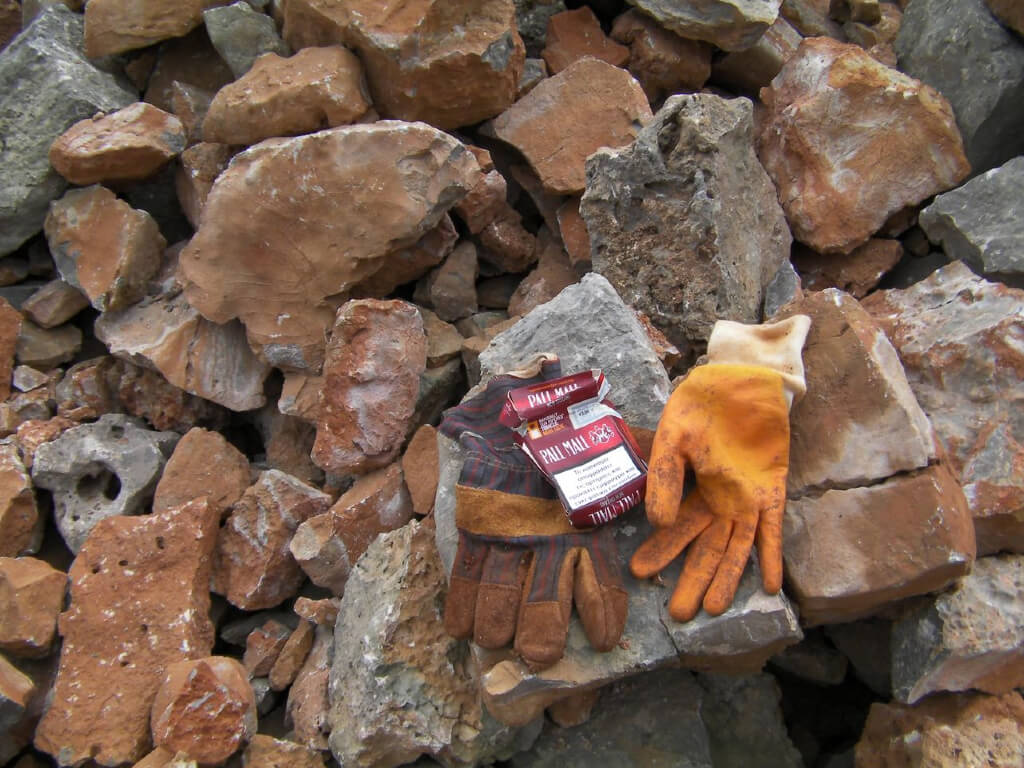
📷 Gloves and a pack of cigarettes left behind by the would-be treasure hunters (photo taken on 14 March 2010). Archive of Emmanouil Fyssas.